6 posts tagged with "Infrastructure"

Infrastructure

View All Tags

We tuned vLLM by hand for 64% more throughput. An agent should have done it.

· 11 min read
Savitha Suresh
Software Engineer

In our last post we fine-tuned a 235B model on four GPUs, then never shipped it, because a newer open model was accurate enough out of the box. So this post is about the next step: serving that model in production. We thought this part was easy. Start vLLM, point traffic at it, done. It wasn't. Fine-tuning is a cost you pay once; serving is a cost you pay every week, and getting it right had its own set of problems. This is what we hit, what we learned, and how we ended up handing the work to an agent.

The task is the same kind as before: read a long, structured document from a customer, find the relevant entities, label each one. Prompts average about 6,500 tokens, and the model reasons before it answers, so outputs are long too. We had one machine with 8× H100 80 GB and served everything with vLLM.

We ended up on Qwen3.6 27B in FP8. It takes about 15× less memory than the 397B we started with[^1] and is just as accurate on this task. Changing how we deployed it got us 64% more output tokens per second on the same eight GPUs, and for the tasks we moved, running them on these GPUs costs 44% less per week than the API bill they replaced.

Most of our time went into finding that setup, one run at a time: change a setting, restart vLLM, run the load test, read the metrics, keep it or revert it. Some of that time was needed. Most was not. Near the end we noticed we had been running by hand the exact loop that Karpathy's autoresearch hands to an agent. The rest of this post is what the hand runs taught us, and why we'd still do the first few by hand.

We fine-tuned a 235B model on four GPUs. Then we didn't need it.

· 8 min read
Savitha Suresh
Software Engineer

We had been using fine-tuned OpenAI and Gemini models to classify entities in our customers' documents. Accuracy was fine. The monthly bill kept growing, so we wanted to know whether we could fine-tune an open model ourselves, on hardware we control, and do at least as well.

We could. One epoch of fine-tuning on about 3,600 examples improved accuracy for every customer we measured, by 7.6 F1 points on average, at about a third of the per-token cost of the API models. The run took 26 hours on four H100s.

We never shipped it. That is the second half of this story. The first half is the five training setups we went through, four of which failed before a single training step ran, because the reason surprised us and it applies to anyone trying to fine-tune a model this size on one machine.

How we made a 13 GB LLM container cold-start in 40 seconds

· 21 min read
Ranjan Ojha
Software Engineer
Ritesh Kadmawala
Founder, Vertexcover Labs - AI-native engineering studio
TL;DR:

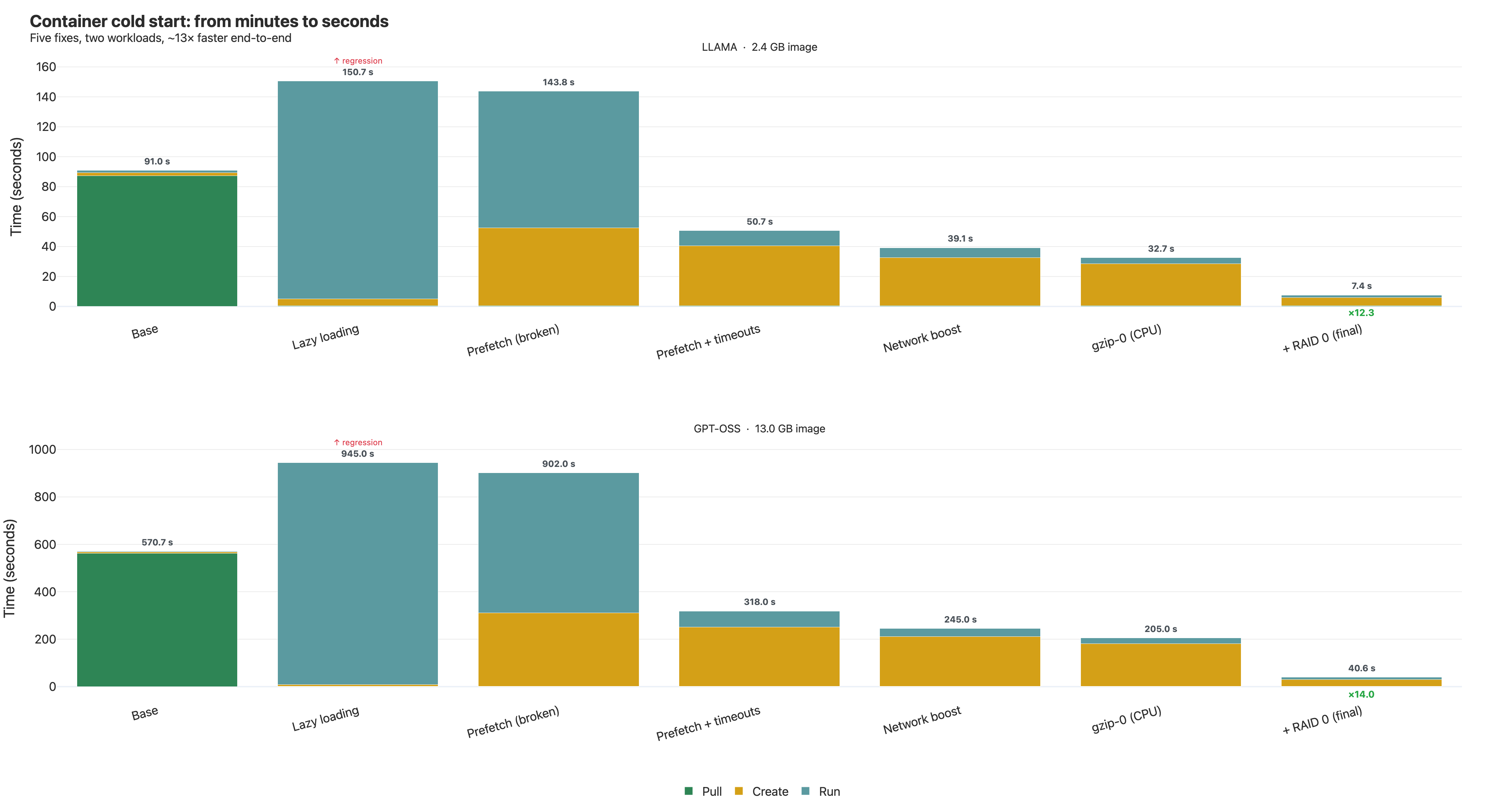
A 13 GB GPT-OSS-20B inference container: 571s → 40.65s. A 2.4 GB Llama-3.2 container: 91s → 7.4s. Same hardware, same app, only the image format and snapshotter config changed.

The obvious first move — lazy loading — made things 66% slower. The biggest single win came from a stack of hidden config knobs we had to read the snapshotter's Go source to find. The last bottleneck wasn't in containerd at all; it was the AWS EBS default write ceiling.

If you ship LLM images and your cold start is over a minute, this is for you.

Cold start journey across five fixes — Llama 3.2 1B (91s → 7.4s) and GPT-OSS 20B (571s → 40.65s)

If you ship a multi-gigabyte ML container — Hugging Face weights baked in, PyTorch + transformers, a FastAPI server — and you've watched the deploy take five-plus minutes from docker run to first inference, this post is the playbook we wish we had.

Why Node.js and Python Don't Use Linux's Native Async I/O API

· 11 min read
Ritesh Kadmawala
Founder, Vertexcover Labs - AI-native engineering studio
TL;DR:

Linux provides a native Asynchronous I/O (AIO) API that should theoretically allow true background file operations. Yet popular frameworks like Node.js and Python's asyncio avoid it entirely, relying instead on thread pools with blocking I/O. Why? The answer reveals important lessons about API design, cross-platform compatibility, and the gap between theoretical elegance and practical engineering. The future may lie in io_uring, a modern interface that addresses many of AIO's shortcomings.

ML Infra design for the GPU Poor

· 5 min read

Taming the Beast: How to Design a Queueing System for GPU-Intensive Workloads​

TL;DR:

When designing for scale, the limiting factor is the GPU availability. So all rate limits / queueing must be designed around GPU availability.